


Executive Summary
Financial institutions face a fundamental efficiency crisis despite decades of technology investment. The average bank operates dozens of separate software applications that function in isolation, creating operational bottlenecks and preventing effective customer service. Processing times reflect systemic constraints. Mortgage approvals average 30-45 days across major markets, while customer onboarding spans multiple systems, driving abandonment rates above 50% for digital channels.
Traditional digital transformation approaches have reached their limits. While API-based integration and cloud migration have improved connectivity and infrastructure flexibility, business logic remains embedded within individual applications, making end-to-end process optimization difficult. Point solutions and incremental improvements cannot address the architectural limitations that create operational friction.
The solution lies in orchestration powered by AI: a fundamental shift from application-centric to process-centric system design. This emerging approach combines artificial intelligence with traditional rule-based logic to create intelligent middleware that coordinates complex workflows across multiple systems without requiring predefined integration paths or wholesale system replacement.
This approach addresses financial services’ unique requirements through hybrid architectures that combine AI agents with conventional rule engines. The additiv platform takes record-keeping data from core banking, CRM, and other systems, enriches it with metadata, and makes it readable for AI agents. Combined with deep process logic, this facilitates complex, multi-step workflows while maintaining regulatory compliance and human oversight.
Early implementations demonstrate breakthrough results across multiple verticals. Lending institutions report 70-80% reductions in approval timeframes, with decisions available within hours rather than weeks for standard applications. Insurance operations achieve 50-80% faster claims resolution for standard cases through intelligent workflow coordination and automated analysis. These outcomes emerge from treating orchestration as the coordination layer across all operations rather than isolated feature additions.
The platform maintains complete data sovereignty, ensuring sensitive information never leaves institutional boundaries and is not shared with underlying base models or external AI providers. Human-in-the-loop architectures preserve human authority over critical business decisions while enabling automation for routine processing.
Financial institutions that embrace this approach can deliver services in hours rather than weeks, provide personalized experiences at scale, and operate more efficiently than competitors constrained by traditional architectures. This technology provides a practical path forward, leveraging existing investments while unlocking transformational improvements in customer experience and operational efficiency.
Part I: The digital transformation challenge in financial services
1. The efficiency plateau: Industry analysis
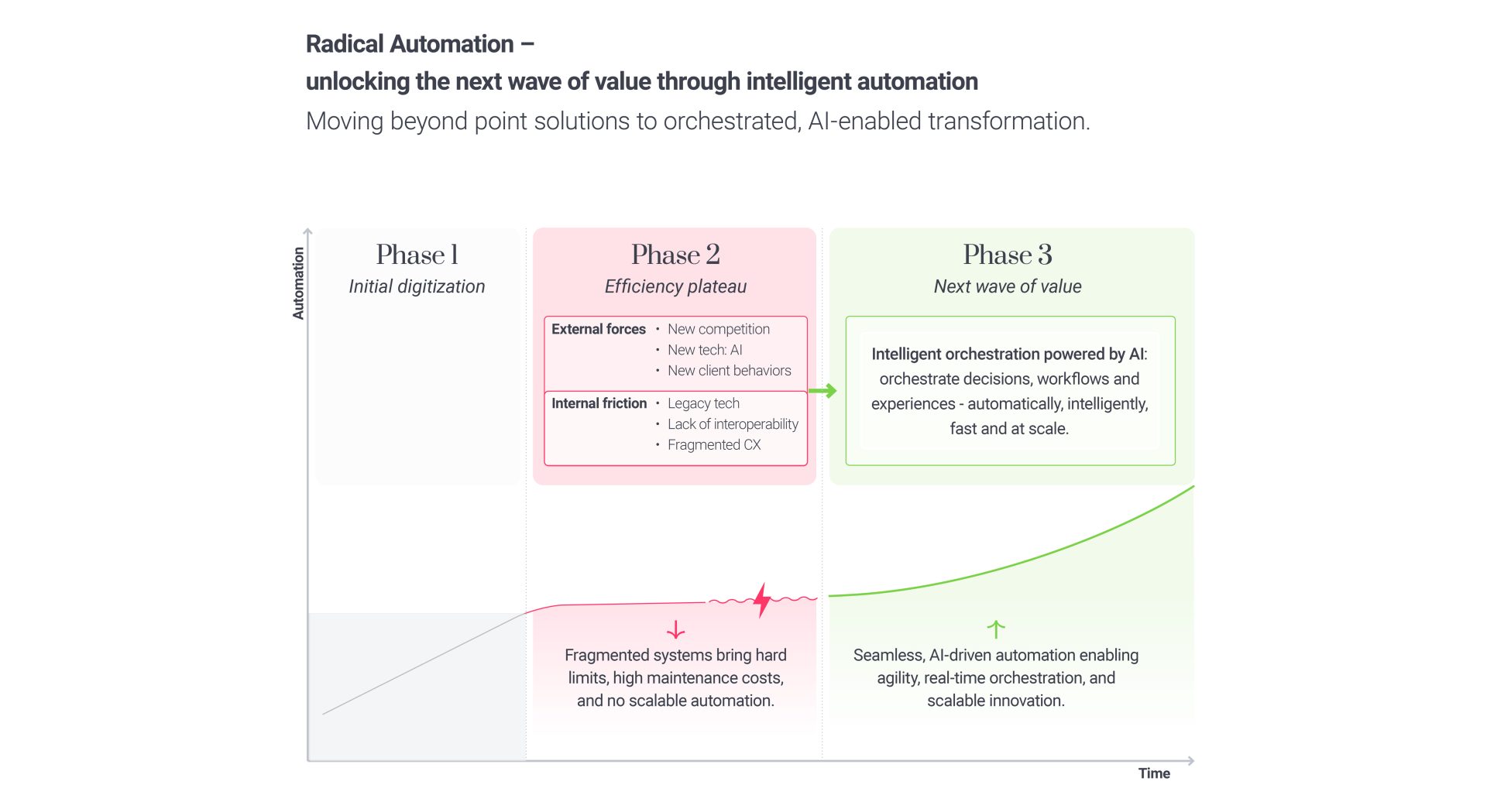
Financial services has reached an efficiency plateau that undermines strategic positioning. Despite massive technology investments over the past two decades, institutions struggle with fundamental operational constraints that prevent effective customer service and competitive positioning against agile fintech challengers.
- The average bank operates dozens of different software applications across its operations. Each application serves specific functions but operates in isolation, requiring manual coordination and creating operational bottlenecks.
- Processing times reflect systemic constraints. Mortgage approvals average 30-45 days across major markets. Customer onboarding spans multiple touchpoints and systems, creating friction-filled experiences that drive abandonment rates above 50% for digital channels.
Meanwhile, digital-native challengers operate with modern, unified platforms that enable rapid innovation and superior customer experiences. These new entrants deliver services in hours or days that traditional institutions require weeks to process, capturing market share particularly among younger demographics who rightly expect seamless digital experiences.
Incremental system improvements cannot address architectural limitations that create operational friction. Financial institutions require a fundamental transformation of how systems coordinate and share information to remain competitive in rapidly evolving markets.
2. Why traditional digital transformation has failed
Most financial institutions have approached digital transformation through point solutions: adding specific technologies to address individual business challenges. This approach provided immediate tactical benefits but created long-term strategic constraints that now limit competitive capability.
The typical transformation journey involved implementing separate systems for customer relationship management, risk assessment, regulatory reporting, document processing, and dozens of other functions. Each system optimized specific workflows but operated independently, requiring custom integration and ongoing maintenance to share data and coordinate processes.
API-based integration and cloud migration have significantly improved connectivity and infrastructure flexibility. Systems can now exchange data more easily and scale dynamically, but operate according to their original design assumptions. These technologies have been crucial enablers of digital transformation, allowing institutions to modernize infrastructure and improve system interoperability. However, they can only take transformation so far. Business logic remains embedded within individual applications, making end-to-end process optimization difficult.
The next step beyond API and cloud adoption is intelligent orchestration: architectural transformation that addresses coordination and decision-making across the entire technology landscape without requiring wholesale system replacement.
Part II: The intelligent orchestration framework
3. Intelligent orchestration powered by AI: The emerging paradigm
Intelligent orchestration powered by AI represents a fundamental shift from application-centric to process-centric system design. Rather than adding AI features to existing applications, this approach treats artificial intelligence as one component of the coordination layer that harmonizes disparate systems and enables adaptive business processes through a combination of AI-driven automation and traditional rule-based logic.
The core principle involves intelligent middleware that understands business context and can coordinate complex workflows across multiple systems without requiring predefined integration paths. This orchestration layer combines AI capabilities with conventional rule engines to create a hybrid approach that relies on data harmonized and unified across different silos, interprets business requirements through both AI-powered analysis and rule-based logic, routes information dynamically, and makes contextual decisions that adapt to changing conditions.
Unlike traditional workflow automation, which follows predetermined paths, the orchestration layer employs both machine learning and conventional business rules to understand patterns and make intelligent routing decisions. The system learns from operational patterns to optimize process flows, reduce bottlenecks, and improve outcomes over time while maintaining the reliability and transparency of rule-based processes where appropriate.
Natural language processing enables business logic definition in terms that domain experts understand rather than technical specifications. Business rule updates can be authored in natural-language-like syntax, reducing reliance on deep technical intervention and enabling rapid adaptation to changing market conditions or regulatory requirements.
This eliminates the need for point-to-point integration by providing centralized coordination that can adapt to different system capabilities. It enables comprehensive customer views by aggregating and contextualizing information from multiple sources while supporting real-time decision-making by coordinating analysis across relevant systems and data sources.
Multi-agent architectures form the technical foundation for orchestration platforms. Both AI agents and traditional rule engines specialize in specific functions—document processing, natural language understanding, predictive analysis, decision support, and rule-based validation—while central coordination ensures coherent business outcomes. This approach enables sophisticated automation while maintaining transparency and control.
Domain-specific financial logic distinguishes this approach from generic business process automation. The orchestration layer must understand regulatory requirements, risk management principles, and customer protection standards that govern financial decisions. This embedded knowledge ensures that both AI-driven and rule-based automation operate within appropriate boundaries.
Rather than humans adapting to software constraints, orchestrated systems adapt to human needs and business requirements. Staff focus on complex decision-making and relationship management while routine coordination and data processing occur automatically.
Industry adoption of intelligent orchestration principles is accelerating as institutions recognize the limitations of traditional approaches. Early implementations demonstrate significant improvements in processing speed, accuracy, and customer satisfaction while reducing operational costs and compliance risks.
4. Core principles of intelligent orchestration in financial services
Intelligent orchestration for financial institutions operates according to principles that distinguish it from generic business process automation. These principles address the unique requirements of regulated financial services while enabling the flexibility and responsiveness that create competitive advantage.
Workflow definition with specialized AI capabilities
The platform begins with clearly defined workflows that incorporate specialized AI agents where they add the most value. The system follows structured business processes while leveraging AI for specific tasks such as document analysis, risk assessment, or customer communication.
AI agents handle specialized functions within these workflows—natural language processing for customer inquiries, computer vision for document verification, or predictive analytics for risk scoring—while the overall process follows defined business logic. This approach ensures reliability and transparency while capturing AI’s benefits where they matter most.
As the system matures, intelligent routing and dynamic decision-making can evolve. Machine learning algorithms can begin to optimize process paths based on outcomes, reducing processing times and improving customer satisfaction over time. This evolution from structured workflows to intelligent routing represents the natural progression of orchestration capabilities.
Data harmonization and comprehensive customer views
Orchestration platforms aggregate information from multiple systems to create comprehensive, real-time customer views. Rather than requiring manual data collection across systems, the platform automatically gathers relevant information and presents it in formats appropriate for specific business contexts. This includes processing both structured data from core systems and unstructured data from documents, emails, and customer communications.
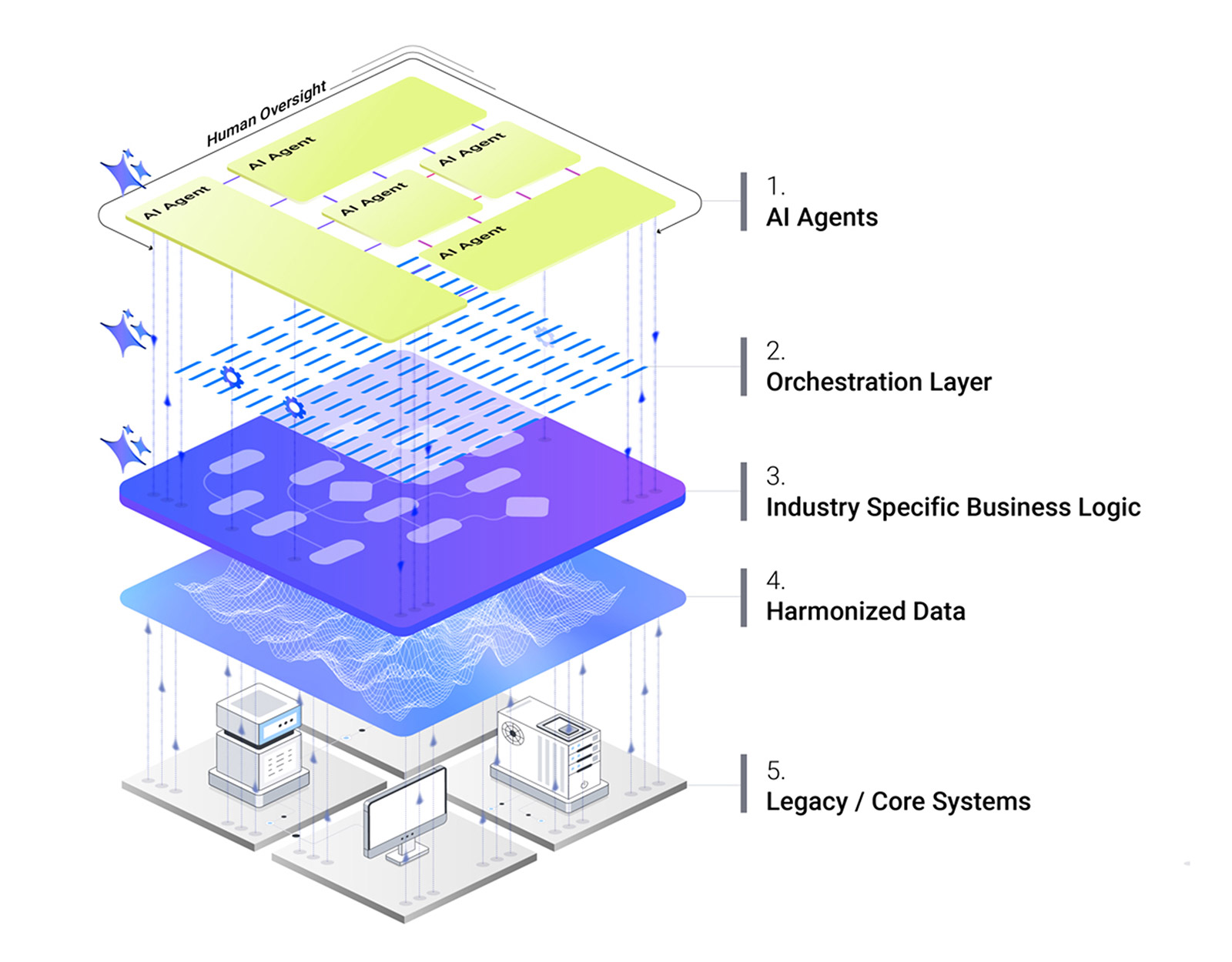
The additiv platform takes record-keeping data from core banking, CRM, and other systems of record, enriches it with metadata, and makes it readable for AI agents. Combined with deep process logic, this approach facilitates complex, multi-step agentic workflows that can handle sophisticated financial processes.
This harmonization addresses one of financial services’ most persistent challenges: fragmented customer information across both structured and unstructured sources that prevents effective service delivery. The orchestration layer reconciles data differences, identifies inconsistencies, and maintains comprehensive profiles that support informed decision-making.
Domain-specific financial logic and regulatory compliance
Intelligent orchestration platforms focused on financial services embed industry-specific knowledge, including regulatory requirements, risk management principles, and customer protection standards. This embedded logic ensures that automated processes operate within appropriate boundaries while maintaining compliance with evolving regulatory frameworks.
The platform understands financial product characteristics, risk assessment methodologies, and regulatory reporting requirements, enabling sophisticated automation while maintaining the control and transparency required for regulated decision-making.
Hybrid AI-deterministic decision-making
Effective orchestration combines AI capabilities with deterministic business rules where regulatory or risk requirements demand predictable outcomes. The system employs machine learning for pattern recognition and process optimization while applying fixed rules for regulated decisions such as credit approvals or compliance checks.
Continuous learning and adaptation
These platforms employ adaptive learning mechanisms (including reinforcement learning where appropriate) to improve performance based on business outcomes rather than just technical metrics. The system tracks customer satisfaction, processing efficiency, error rates, and business results to optimize decision-making algorithms continuously.
This learning capability enables the platform to adapt to changing market conditions, customer preferences, and regulatory requirements without requiring manual reconfiguration. The system becomes more effective over time, providing increasing value to the business.
5. Implementation architecture and design patterns
Platforms dedicated to intelligent orchestration in financial services employ several architectural patterns that address the specific requirements of regulated financial services while enabling the flexibility needed for competitive differentiation.
Multi-agent coordination architecture
The platform employs specialized AI agents and traditional rule engines that focus on specific functions while coordinating through a central orchestrator. Document processing agents handle forms, contracts, and regulatory filings using computer vision and natural language processing. Conversation agents manage customer interactions through multiple channels using advanced natural language understanding. Analysis agents perform risk assessment, fraud detection, and predictive analytics using machine learning models. Traditional rule engines handle compliance validation, regulatory checks, and deterministic business logic.
The central orchestrator coordinates these specialized components, ensuring coherent business outcomes while maintaining oversight and control. This hybrid architecture enables sophisticated automation while preserving transparency and explainability required for regulated environments.
API-first integration strategy
Modern orchestration platforms integrate with existing systems through comprehensive API strategies that minimize disruption to current operations. Rather than requiring deep system modifications, the platform connects through existing interfaces and gradually extends integration as business value becomes apparent.
The platform employs Model Context Protocol (MCP) implementations that translate business intents into secure, auditable API calls. This approach ensures that every action follows established security and compliance procedures while enabling intelligent coordination across the technology landscape.
Composable platform philosophy
Intelligent orchestration platforms employ modular architectures that enable incremental adoption and expansion. Institutions can begin with specific use cases such as document processing or customer onboarding, then gradually expand capabilities as business value becomes clear.
This composable approach aligns with financial institutions’ risk management requirements while enabling rapid time-to-value. Each module connects through the central orchestration layer, creating compound benefits as capabilities expand across the enterprise.
“On any core” deployment strategy
Modern orchestration platforms operate as overlay architectures that coordinate existing systems without requiring replacement or extensive modification. This “on any core” approach enables institutions to leverage existing investments while adding intelligence and coordination capabilities.
The platform abstracts system differences, presenting unified interfaces to business users while managing technical complexity internally. This abstraction enables consistent business processes regardless of underlying system capabilities or constraints.
Part III: Transformation in practice
6. Security, compliance, and risk in intelligent orchestration systems
Security and compliance form fundamental design principles for intelligent orchestration in financial services rather than additions to existing architectures. The platform must address regulatory requirements, risk management standards, and security obligations while enabling the innovation and agility that create business value.
Data sovereignty and privacy protection
Intelligent orchestration platforms maintain complete control over customer and business data, ensuring that sensitive information never leaves institutional boundaries without explicit authorization. Critically, data is not shared with underlying base models or external providers.
Algorithmic transparency and explainable AI
Financial services require transparent decision-making processes that can withstand regulatory scrutiny and customer inquiry. Platforms maintain comprehensive explanation capabilities that describe decision logic, data sources, and outcome rationales in business terms.
Human oversight and control mechanisms
The platforms maintain human authority over critical business decisions while enabling AI to optimize routine processing and coordination. Human-in-the-loop architectures ensure appropriate oversight for high-risk situations while allowing automation for standard cases.
7. Vertical applications and outcomes
Intelligent orchestration transforms specific financial services domains through coordination that addresses industry-specific challenges while delivering measurable business outcomes. The following examples demonstrate how orchestration principles apply across different financial services verticals.
Credit processing and lending operations
Traditional lending operations suffer from sequential processing that creates delays and inconsistent customer experiences.
The platform transforms lending through parallel processing and intelligent coordination. When customers submit applications, orchestration systems simultaneously initiate credit checks, document verification, income analysis, and risk assessment across multiple systems.
Industry implementations demonstrate significant improvements in processing efficiency. Lending institutions report 70-80% reductions in approval timeframes, with decisions available within hours rather than weeks for standard applications.
Insurance operations and claims management
Insurance operations involve complex coordination between multiple departments, external services, and regulatory requirements.
Orchestration platforms transform insurance operations through intelligent workflow coordination and automated analysis. When customers report claims, AI agents simultaneously collect necessary information, analyze supporting documentation, assess fraud risk, and initiate investigation procedures based on claim characteristics.
Processing improvements include 50-80% faster claims resolution for standard cases, with straight-through processing for low-risk claims that meet automated approval criteria.
Wealth management and advisory services
Wealth management has traditionally required high-touch service delivery that limits scalability and increases costs.
The platform enables scalable personalization through automated analysis and recommendation generation. It continuously monitors market conditions, portfolio performance, and customer circumstances to provide personalized insights and recommendations that advisers can review and discuss with clients.
8. Implementation strategy and change management
Successful orchestration implementation requires structured approaches that address technical integration, organizational change, and risk management while delivering rapid business value. Financial institutions must balance innovation objectives with regulatory obligations and operational stability requirements.
Phased adoption strategy
Orchestration implementation begins with targeted use cases that provide clear business value and measurable outcomes. Document processing, customer onboarding, and routine inquiry handling often provide excellent starting points for demonstrating orchestration capabilities while building internal confidence and expertise:
- Phase one focuses on foundational capabilities and proof-of-concept implementations that establish orchestration principles without disrupting critical business processes.
- Phase two expands orchestration capabilities based on initial results, adding more complex workflows and deeper system integration.
- Phase three scales orchestration across multiple business areas.
Organizational change and skills development
Intelligent orchestration transforms operational roles by automating routine tasks and enabling staff to focus on complex decision-making and customer relationship management. Change management programs prepare staff for role evolution while maintaining operational continuity.
Training programs develop skills in AI oversight, exception handling, and advanced customer service that leverage orchestration capabilities. Staff learn to work effectively with AI agents while maintaining authority over critical business decisions.
Governance
Implementation governance ensures that orchestration capabilities operate within institutional risk tolerance and regulatory requirements.
Governance structures include AI ethics committees, model risk management functions, and compliance oversight that monitor orchestration performance and ensure appropriate risk management throughout implementation and operation.
Conclusion: The strategic imperative for intelligent orchestration
The efficiency plateau constraining financial services exists because previous integration approaches could not adapt to the complexity and variability of real-world financial processes. Traditional workflow automation follows fixed paths. API integration connects systems but cannot interpret context or make intelligent routing decisions. Cloud migration provides infrastructure flexibility but leaves business logic fragmented across isolated applications.
Artificial intelligence addresses these limitations through capabilities that were unavailable in earlier integration frameworks. Machine learning algorithms enable orchestration platforms to recognize patterns in operational data and optimize process flows based on observed outcomes. Natural language processing extracts structured information from documents that previously required manual review. Multi-agent architectures coordinate specialized AI capabilities across complex workflows while maintaining deterministic controls where regulatory requirements demand predictable outcomes.
Early implementations provide measurable evidence of performance improvements. Lending operations report approval timeframes reduced by 70-80% through parallel processing and intelligent coordination across credit, documentation, and risk assessment systems. Insurance claims processing achieves 50-80% faster resolution for standard cases. Wealth management platforms extend personalized advisory services to customer segments where manual delivery would be economically unviable.
Institutions can adopt orchestration without replacing existing systems. The platform coordinates current applications through overlay architecture, allowing organizations to start with specific use cases and expand based on results. This phased approach manages risk while improving efficiency and customer experience.
Digital-native challengers built their operations on unified platforms that enable rapid adaptation. Traditional institutions, on the other hand, operate fragmented application landscapes and cannot achieve comparable agility through optimization of individual systems. AI-powered orchestration provides established institutions with architectural capabilities that approach those of digital-native competitors while preserving existing investments and maintaining regulatory compliance standards.
We now have enough live business cases demonstrating that the technology works and can be implemented with appropriate risk controls. The question for institutions is whether their current systems can meet competitive requirements over the next five to ten years.
About additiv AI Studio
additiv AI Studio is a domain-specific orchestration layer that brings intelligent automation to financial services. Purpose-built for wealth, insurance, and credit, it coordinates specialized AI agents with embedded financial logic, unified data, and compliance by design — enabling institutions to automate securely, personalize at scale, and go live fast, without replacing their core.
At its core is a multi-agent system where digital specialists work together across workflows — from onboarding and document processing to proposal generation and client engagement. The orchestration layer connects these agents with existing systems via APIs and manages interactions under deterministic business rules, with full auditability and human oversight.
Whether driving operational efficiency, boosting advisor productivity, or transforming client experiences, additiv AI Studio delivers measurable value through orchestrated intelligence — accelerating transformation without disruption.
Break through the efficiency plateau. Be more innovative. Be more additiv.